

How a Telescopic Truck-Loading Conveyor Works and Why It Matters
A telescopic conveyor is a multi-stage, extendable boom that slides directly into a trailer or container to move cartons, parcels, bags, and other unit loads with minimal manual handling. Unlike fixed dock conveyors, its sections extend and retract to follow the working face of the load, keeping items within easy reach of the operator throughout the trailer. Most designs feature powered belts or rollers, height adjustment for ergonomic positioning, and intuitive controls that let teams reverse flow for both loading and unloading. The result is a compact, mobile, and high-throughput solution tailored to the intense pace of modern truck loading and cross-docking.
In practice, the technology shortens walking distance dramatically. Without an extendable boom, pickers or loaders often walk deep inside trailers, lift and carry items across uneven stacks, and repeat the cycle thousands of times per shift. By projecting the conveyor deep into the trailer—often 9 to 15 meters depending on the number of stages—workers position themselves at the ideal envelope, guiding items rather than carrying them. This reduces fatigue and the risk of musculoskeletal injuries while boosting consistency during peak periods. Operations in express parcel, e-commerce fulfillment, third-party logistics, and manufacturing shipping docks frequently report cycle-time reductions of 30–50% after adopting telescopic systems.
Because truck fleets, dock layouts, and load profiles vary, telescopic conveyors come in belt or roller formats, with options like articulating noses to reach floor-level seams, VFD-driven speed control, integrated LED lighting, and traverse mechanisms that let one machine service multiple doors. Safety layers such as emergency-stop buttons, pull cords, soft-touch bumpers, photoelectric sensors, and anti-collision logic further protect people and product. For sites migrating toward automated logistics, these units can interface with upstream scanners, weigh-dimensioning systems, and sorters so that the entire last-50-feet flow feels coordinated rather than fragmented.
Used effectively, a telescopic conveyor for truck loading can become the anchor of a dock strategy that saves floor space and labor while lifting throughput. Whether feeding from a loop of flexible conveyors, a pick tunnel, or a high-speed sorter, the extendable boom acts as the decisive bridge between building and vehicle. For teams comparing options or planning a retrofit, exploring models of telescopic conveyor for truck loading helps align specifications with real-world demand patterns and trailer fleets.
Choosing the Right Specification: Key Features, Sizing, and Safety Options
Getting the specification right starts with a clear profile of the loads and vehicles. Identify the smallest and largest parcels or cartons, their average weight, and any irregular items like tires, sacks, or polybags that require additional containment or belt texture. Measure the typical trailer length (28–53 ft or 40 ft containers), door spacing, dock height, and the feed height from upstream equipment. From there, select the boom length—often three- or four-stage configurations—to ensure the nose comfortably reaches the trailer nose without overextension. Belt widths commonly range from 600 to 1000 mm; heavier, bulkier cartons may need wider belts, while high-velocity parcel work can benefit from narrower belts with higher speeds and tighter control.
Consider mobility and reach. A fixed chassis suits single-door, high-throughput bays. For multi-door flexibility, a traversing base on rails or a free-moving mobile chassis can let one unit serve multiple doors. Height adjustment via hydraulic or electric actuators ensures ergonomic positioning across different trailer floor heights. Some operations add an articulating tongue or “drop-down” nose to place product more precisely at floor level and reduce stacking strain. Controls with VFD speed tuning, easy jog/reverse, and programmable extension memory help standardize workflows and minimize operator error during intense shifts.
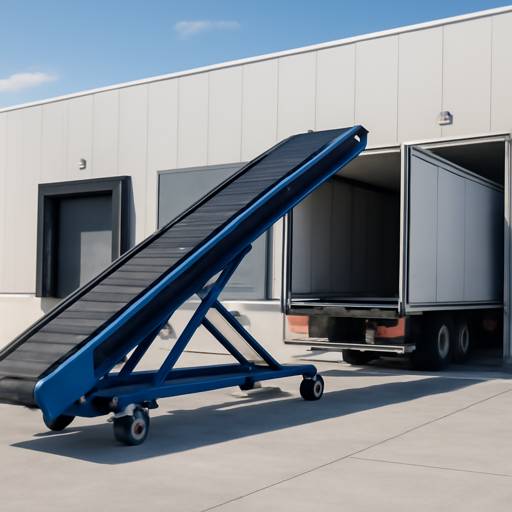
Safety is non-negotiable when equipment enters a confined trailer space. Look for redundant emergency-stop coverage, pull cords along the boom, guarded pinch points, soft-touch bumpers, and light/sound beacons that warn of movement. Photo-eyes at the nose can pause extension when approaching walls or stacked goods, and torque-limiting drives mitigate pinch forces. Conformity with regional standards (CE marking, ISO guidance, or OSHA-aligned practices) underscores a commitment to safe deployment. Clear signage, lockout/tagout provisions, and training reinforce the engineering layers with disciplined procedures, keeping people protected during both routine use and maintenance.
Serviceability and lifecycle cost matter as much as the purchase price. A preventive maintenance plan—daily visual checks, belt tracking and tension verification, roller and bearing inspections, cleaning dust and tape debris, and periodic drive and control audits—prolongs belt life and drive reliability. Stocking critical spares (belts, bearings, nose rollers, sensors, and HMIs) can shrink downtime from days to hours. Energy-efficient motors and sleep modes reduce idle consumption when booms pause between trucks. For data-driven sites, optional telematics or PLC connectivity can supply uptime metrics, cycle counts, and fault histories that help teams fine-tune staffing, dock scheduling, and peak-readiness. Aligning these features with your real dock constraints ensures the chosen extendable conveyor elevates throughput without introducing maintenance surprises.
Real-World Applications and ROI: From E-commerce Peaks to Cross-Border Hubs
High-velocity parcel networks live and die by dock cadence. In busy hubs, a well-specified telescopic conveyor turns door bottlenecks into predictable flow. Consider a regional e-commerce facility pushing 10,000–20,000 parcels per hour across multiple doors. Before deploying extendable booms, teams may assign three to four people per trailer: two deep inside staging, another relaying to the dock, and a loader stacking. After installing boom conveyors with programmable extension and nose lighting, the same trailer can be handled by one to two operators who guide parcels at the trailer face. Average load time per 53 ft trailer drops from 12 minutes to 6–8 minutes, while walking distance and lifting frequency fall sharply—an immediate win for both ergonomics and output.
Cross-border logistics and export corridors also benefit. Operations shipping cartons to ocean containers or linehaul trucks must cope with variable vehicle conditions, last-minute consolidation changes, and diverse packaging quality. A truck loading setup that pairs telescopic belts with flexible skate-wheel or powered flexible conveyors can form pop-up lines to absorb surges—Black Friday peaks, month-end pushes, or seasonal promotions—without permanent floor encumbrance. The ability to retract and park booms keeps the dock clear for housekeeping, audits, and trailer maintenance, improving safety scores and audit readiness.
Manufacturers shipping finished goods often see compelling ROI because outbound flow is predictable and repeatable. A plant that previously used forklifts to stage pallets near doors and then manual carry for carton top-offs might introduce a four-stage belt with an articulating nose, integrated counters, and VFD control. With consistent carton handling at an ergonomic height, dock teams eliminate the last-5‑meter carry, shrink non-value-added motion, and raise trailer fill quality. A typical outcome: 25–40% uplift in door throughput, 1–2 fewer people required per door in steady-state operation, and a reduction in minor handling injuries thanks to fewer twists, bends, and overreaches. Training crews to use the boom’s extension memory and speed presets further stabilizes cycle times across shifts.
Regional service models strengthen reliability. Many facilities operate around the clock, making remote diagnostics and fast spare-part support essential. Telematics-enabled control systems can flag anomalies like belt mistracking, motor overtemperature, or sensor faults before they trigger stoppages. Combined with quarterly preventive maintenance and a simple daily checklist—inspect the belt edge, clear debris at the nose, test e-stops, confirm lights and alarms—teams protect uptime during critical windows such as late-night sortation or morning dispatch. Environmentally, telescopic conveyors cut forklift travel at the dock and shorten engine idling by trimming the time trucks sit at doors, supporting both cost and sustainability targets. In contexts ranging from express parcel networks to export-oriented hubs, the humble telescopic conveyor proves to be a high-leverage asset that turns dock variability into disciplined, predictable flow.
 Lucía Gómez